Your European Health Insurance Card can save you roughly €148 per month on German student health insurance. But only if you use it correctly, and only if you understand exactly where its coverage ends. Every year, EU students show up at German universities assuming their EHIC works like a regular insurance card. It doesn't. And the gap between what students expect and what actually happens at a doctor's office in Munich or Berlin can be expensive and stressful.
After helping thousands of EU students compare health insurance options on ExpatNav, we've seen one pattern over and over: students either overpay for coverage they don't need or under-insure themselves because they misunderstood what their EHIC actually covers in Germany. This guide breaks down exactly how the EHIC works for EU students, what the M10 enrollment process looks like, where the coverage gaps are, and when you should seriously consider switching to German statutory insurance instead.
Table of Contents
- Quick Answer: Can EU Students Use EHIC in Germany?
- What the EHIC Actually Is (and Isn't)
- How to Use Your EHIC for University Enrollment: The M10 Process
- What Your EHIC Covers in Germany
- The Real Coverage Gaps You Need to Know About
- Erasmus Students vs. Full-Degree Students: Different Rules
- When You Should Switch to German Health Insurance
- EHIC vs. German Student Insurance: Cost Comparison
- Common Mistakes EU Students Make with EHIC
- FAQ
- Conclusion
Quick Answer: Can EU Students Use EHIC in Germany?
Yes, EU and EEA students with a valid EHIC can use it as proof of health insurance for university enrollment in Germany. You won't need to buy separate German health insurance as long as you remain insured under your home country's statutory system and your EHIC stays valid throughout your studies. However, you will still need to get an M10 notification from a German statutory health insurer (like TK or BARMER) confirming your exemption. Without the M10, most universities won't let you complete enrollment.
Here's a quick overview of how the EHIC applies to different student types:
Student Type | EHIC Sufficient? | German Insurance Needed? | Key Condition |
|---|---|---|---|
Erasmus exchange (1-2 semesters) | Yes | No | Must stay insured in home country |
Full-degree EU student (under 30) | Usually yes | Recommended for long stays | Center of life must remain in home country |
EU student with a part-time job | No | Yes, mandatory | Employment triggers German insurance obligation |
EU student receiving BAfoG | No | Yes, mandatory | German subsidies require German insurance |
Studienkolleg / language course student | No | Yes (private) | Not considered students under social insurance law |
What the EHIC Actually Is (and Isn't)
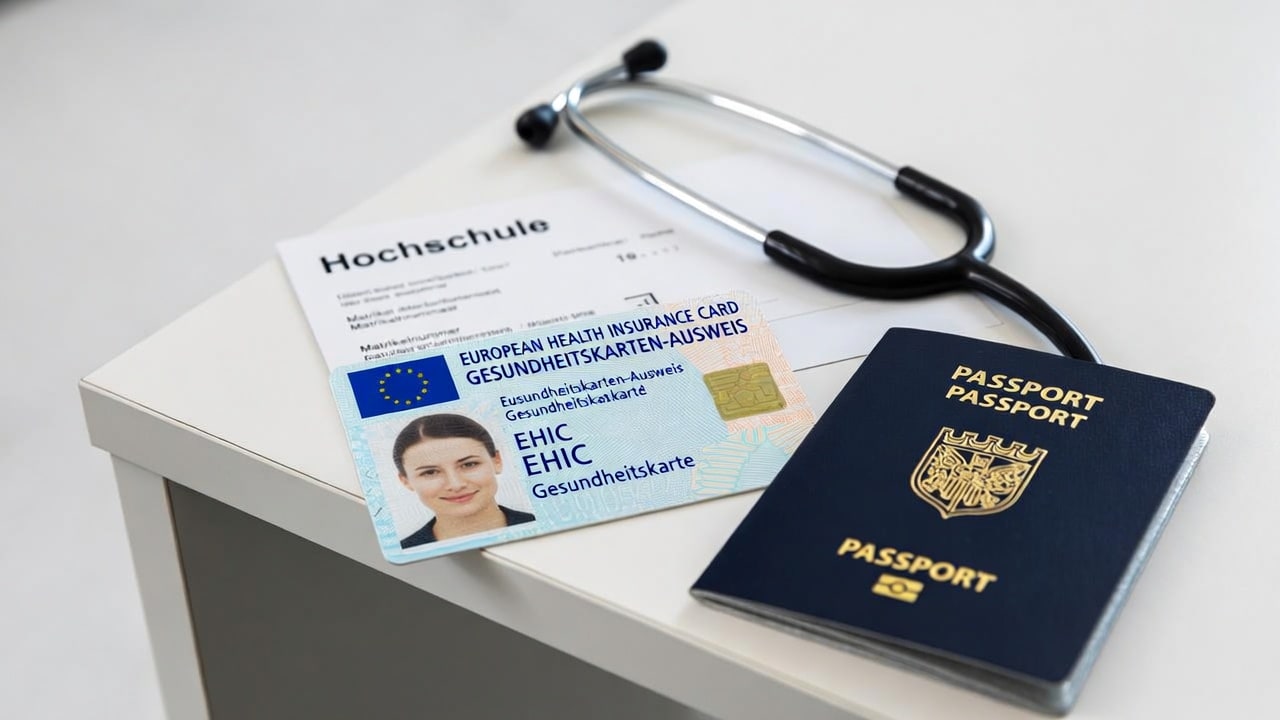
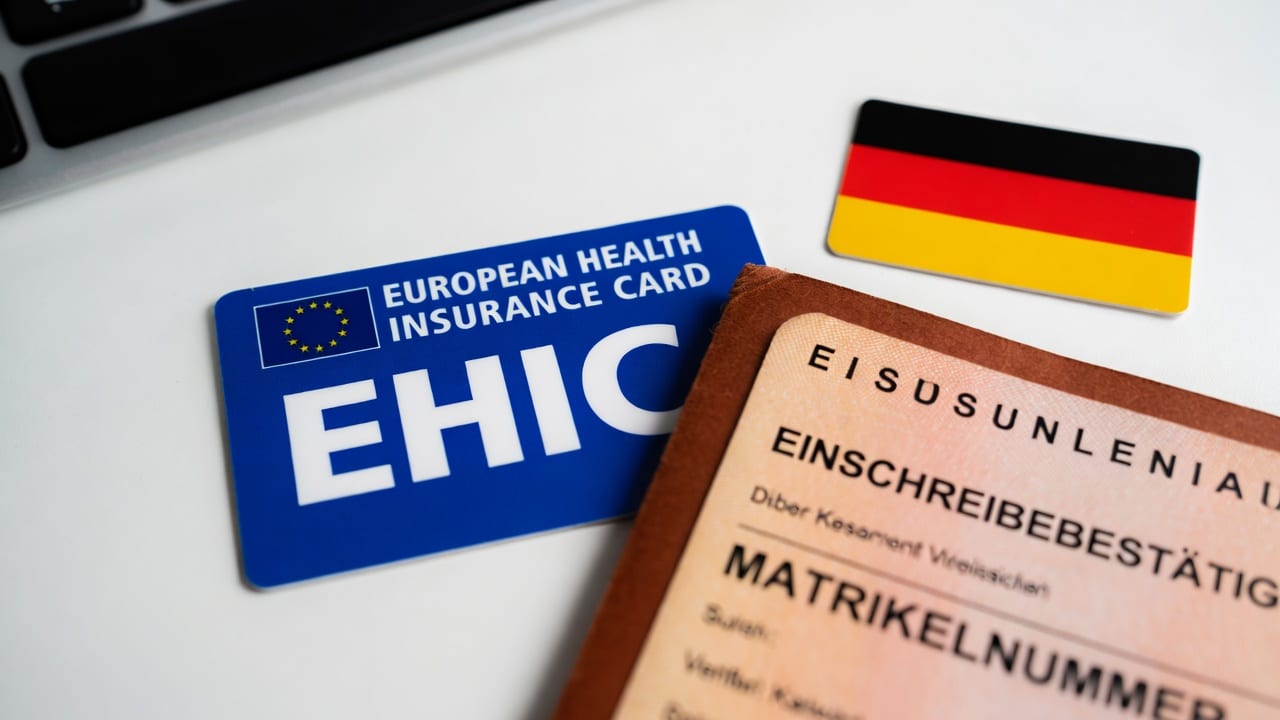
The European Health Insurance Card is a free card issued by your home country's statutory health insurance provider. It gives you access to medically necessary healthcare in all 27 EU member states, plus Iceland, Liechtenstein, Norway, Switzerland, and the United Kingdom. You receive treatment under the same conditions and costs as locally insured residents.
Here's what trips up most students: the EHIC was designed for temporary stays abroad. It covers medically necessary treatment during your visit, which means the doctor decides what's necessary based on the expected length of your stay. If you're in Germany for a two-week vacation, that covers different things than if you're here for a four-year degree program.
The European Commission is clear about one thing: the EHIC is not a substitute for travel insurance. It doesn't cover private healthcare providers, medical repatriation to your home country, or planned treatments you traveled to Germany specifically to receive. And in practice, its coverage can differ significantly from what you're used to at home, because you're covered under German statutory rules, not your home country's rules.
For students specifically, here's the critical point: a valid EHIC, combined with the M10 exemption notification, satisfies the mandatory health insurance requirement for university enrollment. You don't need to pay for German student health insurance (currently around €148/month in 2026) if your home coverage stays active.
How to Use Your EHIC for University Enrollment: The M10 Process
Every student enrolling at a German university needs proof of health insurance, regardless of nationality or insurance type. Since January 2022, this proof is handled digitally through the M10 notification system. A German statutory health insurer sends an electronic message directly to your university confirming your insurance status. No paper certificates, no PDFs you carry around.
Here's how it works, step by step:
Step 1: Get your EHIC before leaving home. Check that your card is valid and won't expire during the semester. The EHIC is typically printed on the back of your national health insurance card, but some countries issue it separately. If you can't get one in time, request a Provisional Replacement Certificate (PEB) from your insurer. It works the same way.
Step 2: Choose a German statutory health insurer to process your M10. You can pick any one. Techniker Krankenkasse (TK) is the most popular choice among international students because they offer the service online, in English, and free of charge. BARMER and AOK are also common options.
Step 3: Submit your EHIC to the German insurer. For TK, you upload photos of the front and back of your EHIC through their online portal for EU students. You'll also provide your admission letter details and the university's sender number (Absendernummer). Every university has a unique number, and you'll find it in your enrollment documents.
Step 4: The insurer sends the M10 to your university. TK typically processes this within one week. The M10 confirms that you're exempt from mandatory German statutory health insurance because you're already covered through your home country. Your university receives it digitally. You don't need to submit anything else related to insurance.
Step 5: Complete enrollment. Once your university receives the M10, you've satisfied the health insurance requirement. Some universities ask you to write "EXEMPT" in the health insurance field of your enrollment form.
One thing to keep in mind: this M10 is not the same as an exemption from statutory insurance (Befreiung von der Versicherungspflicht). The exemption for students with private insurance is irreversible for the duration of your studies. The EHIC-based M10 simply validates your existing coverage. If your home insurance ends or you start working in Germany, you can still switch to German statutory insurance.
What Your EHIC Covers in Germany
With a valid EHIC, you receive medically necessary treatment from any doctor or hospital that's part of Germany's statutory health insurance system (Kassenarzt or Vertragsarzt). Look for practices displaying "alle Kassen" (all insurance funds) or "gesetzlich versichert" (statutorily insured). Your treatment is billed through the German system, and your home country's insurer handles reimbursement behind the scenes.
Coverage includes:
General practitioner visits for illness or injury
Specialist referrals when medically necessary
Hospital stays for acute conditions, surgery, or emergencies
Prescription medications (with standard German co-payments of €5-10 per item)
Ongoing care for chronic or pre-existing conditions like diabetes, asthma, or epilepsy
Pregnancy and maternity care
Emergency dental treatment (acute pain, fractures, abscesses)
Mental health treatment is deemed medically necessary
At the doctor's office, you'll fill out a "Patient Declaration of European Health Insurance" form (Patientenerklarung). The practice provides it, and it's available in multiple languages. You'll name a German statutory insurer on the form (use whichever one processed your M10), and the billing gets handled from there. In most cases, you pay nothing out of pocket beyond the standard co-payments that German residents also pay.
The Real Coverage Gaps You Need to Know About
This is where things get tricky, and where we see EU students run into problems. Based on what users report on ExpatNav, these are the most common gaps:
Dental care beyond emergencies. Your EHIC covers emergency dental work like treating an abscess or a broken tooth. It does not cover routine checkups, cleanings, fillings for cavities, crowns, or orthodontic work. German statutory insurance itself only partially covers dental, so the EHIC mirrors those limitations. If you need a crown, you could be looking at €300-500 out of pocket.
Private practices won't accept it. Germany has a two-tier healthcare system. Private practices (Privatpraxis) don't bill through the statutory system and won't accept your EHIC. You'd need to pay the full bill upfront and try to get reimbursement from your home insurer, which often only reimburses at statutory rates. Depending on the treatment, that could cover half or less of the actual cost.
Preventive care is limited. Annual health checkups, cancer screenings, and other preventive exams are technically part of Germany's statutory benefit package. But whether your EHIC covers them depends on what your home country's system includes. If your home country doesn't offer a particular screening, you might not be covered for it in Germany either. The rules here are genuinely confusing, and even some doctors aren't sure how to bill it.
Mental health therapy. While emergency psychiatric care is covered, ongoing psychotherapy can be a gray area. Getting approved for a therapy course through the statutory system already takes months for German residents. With an EHIC, the approval process is even less straightforward.
No coverage at all if your home insurance lapses. This is the biggest risk. If you stop paying premiums in your home country, if your parents' insurance no longer covers you because of your age, or if your home insurer decides you've been abroad too long, your EHIC becomes invalid. And you might not find out until you're sitting in a doctor's office in Germany. We've heard from students on ExpatNav who discovered their coverage had lapsed only when a claim was rejected months later.
Co-payments you might not expect. German statutory rules include co-payments for hospital stays (€10/day for up to 28 days per year), some prescription drugs, and certain medical aids. These apply to EHIC holders just like they apply to German residents.
Erasmus Students vs. Full-Degree Students: Different Rules
Erasmus exchange students and full-degree EU students are treated differently under the EHIC system, and the distinction matters.
Erasmus students stay enrolled at their home university and remain fully insured under their home country's statutory system. The EHIC covers medically necessary services in Germany under the same conditions as German statutory insurance. For a one or two-semester exchange, this is generally sufficient. Your home insurer knows you're temporarily abroad, and your coverage is designed to continue.
Full-degree EU students (those enrolled directly at a German university for a bachelor's, master's, or PhD) are in a more complicated position. The EHIC technically works if your center of life remains in your home country. But after one to two years, many home country insurers stop considering you a temporary resident abroad. Some insurers proactively cancel coverage for students who have been abroad for extended periods.
If you're planning to stay in Germany for three or more years, it's worth verifying directly with your home insurer whether they'll maintain your coverage for the full duration. Get this in writing. A phone call isn't enough if things go wrong later.
Students from EU/EEA countries who receive German state funding (like BAfoG) or who intend to settle in Germany permanently are required to take out German statutory health insurance. The EHIC option no longer applies.
When You Should Switch to German Health Insurance
The EHIC saves you money, but it's not always the best choice. Based on what we've seen from ExpatNav users, here are the situations where switching to German statutory insurance (Gesetzliche Krankenversicherung, or GKV) makes more sense:
You take a part-time job or a minijob. The moment you start working in Germany, even in a mini-job, you may become subject to mandatory German social insurance. This means you need German statutory health insurance. Your EHIC won't cover the employment-related insurance requirement.
You plan to stay more than two years. Long stays increase the risk of your home coverage lapsing. German student health insurance costs around €148/month in 2026, but it gives you full statutory coverage with no gaps, plus you build a relationship with the German system that's useful if you stay after graduation.
You need regular dental or specialist care. If you know you'll need ongoing treatment, German statutory insurance provides clearer, more predictable coverage than relying on EHIC cross-border billing.
You turn 30 during your studies. Age 30 is a critical threshold in Germany. Under 30, you qualify for discounted student rates in statutory insurance. If you're currently on EHIC and switch after turning 30, you'll pay the higher voluntary insurance rate (roughly €210+/month). If you think you might need German insurance eventually, it's cheaper to switch before 30.
Your home insurer is unreliable about cross-border billing. Some home country insurers are slow to process German claims or reject certain treatments. If you're constantly fighting with reimbursement, the stability of German coverage may be worth the monthly cost. ExpatNav's health insurance comparison tool shows you the actual monthly costs for your situation so you can compare options side by side.
EHIC vs. German Student Insurance: Cost Comparison
Here's a real cost breakdown for EU students under 30 in 2026:
EHIC (Home Country Insurance) | German Statutory Student Insurance | |
|---|---|---|
Monthly premium | €0 additional (covered by home insurer) | ~€148/month |
Annual cost to you in Germany | €0 (but you pay home premiums) | ~€1,776/year |
Dental coverage | Emergency only | Basic statutory (60-75% for major work) |
Private doctor access | Not covered | Not covered (same limitation) |
Mental health therapy | Complex cross-border billing | Standard statutory pathway |
Enrollment process | EHIC + M10 via TK/BARMER | Direct enrollment with a Krankenkasse |
Coverage if you start working | Need to switch to German insurance | Already covered |
Risk of coverage gaps | Moderate (depends on home insurer) | Very low |
For a two-semester exchange, the EHIC is almost always the better financial choice. For a full degree program, the calculation depends on your home insurance situation and your plans for working or staying after graduation.
Not sure which option fits your situation? ExpatNav's eligibility filter shows you which health insurance providers accept your nationality and visa type, so you can compare only the options that actually work for you.
Common Mistakes EU Students Make with EHIC
After years of building ExpatNav and talking with EU students going through the German system, these are the mistakes we see again and again:
Mistake 1: Assuming the EHIC is a full insurance card. It's not. It's a portability mechanism for your existing home coverage. If your home coverage is limited, your EHIC in Germany is equally limited. Check what your home insurance actually covers before you rely on it.
Mistake 2: Forgetting the M10 process. You can't just wave your EHIC at the enrollment office. Every German university requires the electronic M10 notification from a statutory health insurer. Start this process at least two weeks before your enrollment deadline.
Mistake 3: Not checking if your EHIC is still valid. EHICs have expiration dates. Some countries issue them for one year, others for longer. If your card expires mid-semester, you need a replacement before you can see a doctor.
Mistake 4: Going to a private doctor. Private practices in Germany don't accept EHIC. Always look for "Kassenarzt" or "alle Kassen" when choosing a doctor. Check platforms like Doctolib or Jameda and filter for statutory insurance doctors (gesetzlich versichert).
Mistake 5: Not keeping receipts for out-of-pocket payments. If you do end up paying for something (co-payments, rejected EHIC at a practice, pharmacy costs), keep every receipt. You may be entitled to reimbursement from your home insurer, but only if you have documentation.
Mistake 6: Ignoring the work trigger. Taking a Werkstudent job or even a Minijob can trigger mandatory German social insurance enrollment. If you start working and don't switch your insurance, you could end up uninsured without realizing it. When you settle into life in Germany and start looking at finances more broadly, having a proper German bank account becomes important too, especially for receiving wages.
FAQ
Do I need to cancel my EHIC if I switch to German health insurance?
No. You don't cancel an EHIC. It simply becomes inactive once you enroll in German statutory health insurance. Your German Krankenkasse will issue you a new eHealth card, which actually has an EHIC printed on the back for when you travel to other EU countries.
Can I use my EHIC at any hospital in Germany?
You can use it at any hospital or doctor that participates in the statutory health insurance system (gesetzliche Krankenversicherung). Private hospitals and private practices generally don't accept it. In an emergency, any hospital will treat you regardless.
What if my EHIC gets rejected at a doctor's office?
Pay the bill and get a detailed invoice. Then submit it to your home country insurer for reimbursement. You can also try a different practice, because some doctors are unfamiliar with EHIC billing procedures and reject it unnecessarily.
Is the UK GHIC accepted the same way as an EHIC in Germany?
Yes. Since Brexit, the UK issues a Global Health Insurance Card (GHIC) that functions the same as an EHIC in EU countries, including Germany. The M10 process works the same way for GHIC holders.
Can I use my parents' EHIC?
No. You need your own EHIC. If you're covered under your parents' insurance in your home country, your insurer will issue you your own card. Each person needs their own EHIC.
Does EHIC cover me during semester breaks if I travel within the EU?
Yes. As long as your home insurance remains active, your EHIC covers medically necessary treatment in all EU/EEA countries and Switzerland. This applies whether you're in Germany or traveling elsewhere during breaks.
What happens after I graduate? Does my EHIC still work?
If you stay in Germany after graduating, your EHIC technically remains valid as long as your home insurance stays active. If you register as a job seeker at the Agentur fur Arbeit, you can continue using your home coverage for up to six months. After that, or once you start working, you'll need German insurance. Our first 14 days checklist covers the key steps for getting settled.
I'm from an EU country but I have private insurance at home, not public. Can I still get an EHIC?
No. The EHIC is only issued to people covered under statutory (public) health insurance in their home country. If you have private insurance, you'll need to check whether your policy covers you in Germany and apply for a separate exemption through the M10 process with documentation from your private insurer.
Conclusion
For EU students heading to Germany, the EHIC is a genuinely useful tool that can save you over €1,700 per year in insurance premiums. But it's only useful if you understand its boundaries. Get your M10 sorted early through TK or BARMER, verify that your home coverage will last the full duration of your studies, and know where the gaps are so you're not caught off guard at a doctor's office.
If you're doing a short exchange, the EHIC is probably all you need. If you're planning a full degree, working part-time, or staying beyond graduation, switching to German statutory insurance might save you a lot of headaches down the road.
Not sure which health insurance option works for your specific situation? ExpatNav's health insurance comparison filters providers by your nationality and visa type, so you see only the options that actually accept your profile.
ExpatNav may earn a commission if you sign up for a provider through our links. This never affects our rankings or recommendations. Pricing data in this article was verified in April 2026.